

The digital infrastructure underpinning the American education system faced a seismic disruption this May, as the widely used learning management system (LMS) Canvas, operated by Instructure, became the epicenter of a massive, high-stakes data extortion campaign. The breach, orchestrated by the notorious cybercrime syndicate ShinyHunters, paralyzed operations for thousands of K-12 school districts and universities, triggering a panicked scramble during the height of the academic final exam season.
The incident serves as a harrowing case study in the vulnerabilities of centralized educational technology. What began as a series of isolated security warnings escalated into a public defacement of the platform’s login portal, forcing the company to take the unprecedented step of shutting down portions of its service to contain an adversary that had seemingly bypassed corporate security protocols not once, but repeatedly.
Chronology of a Digital Siege
The crisis did not emerge overnight; rather, it was the culmination of an escalating pattern of intrusion that stretched back months.
The Prelude: September 2025
The first signs of trouble appeared in late 2025, when ShinyHunters leaked sensitive internal files from the University of Pennsylvania, including donor records and confidential memos. While the industry largely framed the event as a localized incident targeting the university, security experts now view it as a "proof of concept." The attackers had successfully leveraged an access path mediated by Instructure, testing their ability to exfiltrate data through the platform’s ecosystem.
The Escalation: May 1–2, 2026
On May 1, 2026, ShinyHunters signaled their return, claiming to have breached Instructure’s core environment. They threatened to leak data belonging to 275 million students and faculty members across 9,000 institutions. On May 2, Instructure’s Chief Information Security Officer, Steve Proud, issued a public statement declaring that the incident had been "contained" and that the platform remained operational. This confidence would soon prove to be premature.
The Public Defacement: May 7, 2026
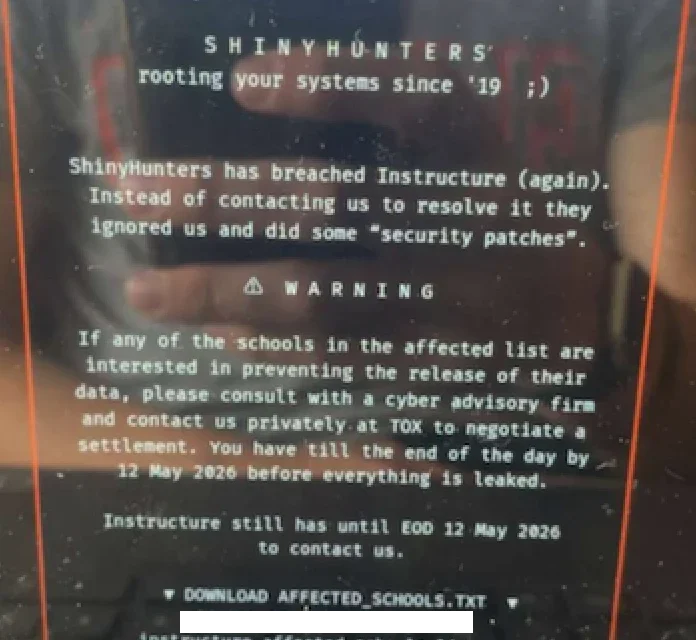
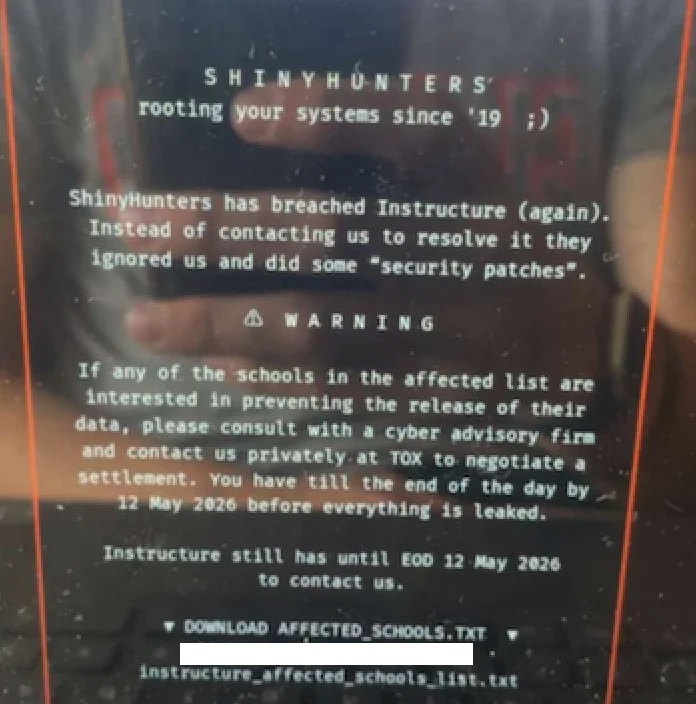
By mid-day on May 7, the facade of normalcy collapsed. Students and faculty across the U.S. reported that the Canvas login page had been hijacked. Instead of the standard portal, users were greeted by a ransom demand from ShinyHunters, mocking Instructure’s previous attempts at "security patches." Instructure was forced to take the service offline, replacing the site with a generic "scheduled maintenance" notice—a move that drew sharp criticism from industry analysts who viewed the terminology as a dishonest attempt to downplay a security catastrophe.
The Resolution: May 11, 2026
Following days of instability and mounting pressure from affected institutions, Instructure broke its silence on May 11 with a startling admission: the company had paid the ransom. The firm claimed it had received digital confirmation—specifically "shred logs"—that the stolen data had been destroyed and that no further extortion attempts against its customers would occur.
Anatomy of the Breach: The "Free-for-Teacher" Vulnerability
As the dust settled, investigations revealed that the gateway for the breach was the platform’s "Free-for-Teacher" accounts. This segment of the service, designed to allow individual educators to use Canvas independently of institutional contracts, became the primary vector for unauthorized access.
On May 8, Instructure confirmed that the attackers exploited an identical issue in the "Free-for-Teacher" portal twice in one week. The company made the difficult decision to temporarily shutter these accounts, effectively cutting off thousands of independent educators to prevent further exploitation.
While Instructure maintained that the stolen data was limited to names, email addresses, student ID numbers, and user messages—insisting that sensitive items like financial information and social security numbers remained untouched—the breach exposed the inherent risks of "shadow IT." When individual teachers sign up for services outside of formal district IT oversight, they create blind spots that cybercriminal groups like ShinyHunters are increasingly adept at exploiting.
The Rise of ShinyHunters: A Prolific Cyber-Threat
The group behind the attack, ShinyHunters, has evolved into one of the most feared entities in the cybercrime landscape. Their methodology is characterized by a "fluid" approach to infiltration, relying heavily on sophisticated social engineering and voice phishing (vishing) to compromise single sign-on (SSO) credentials.
The Canvas breach follows a string of high-profile successes for the group. Just one month prior to the Canvas incident, ShinyHunters successfully breached the home security giant ADT, exfiltrating personal information belonging to 5.5 million customers. By compromising an employee’s Okta account, they gained lateral movement into the company’s Salesforce instance.
Charles Carmakal, CTO of Mandiant Consulting, noted that the Canvas attack was not an isolated event but rather one of several "concurrent and discrete" campaigns the group was running simultaneously. Other victims of the group’s recent activities include high-profile names such as Medtronic, Rockstar Games, and the cruise line operator Carnival. Their business model is simple: infiltrate, exfiltrate, and force the victim—or their partners—to pay to prevent the public disclosure of stolen information.
Implications for Educational Institutions
The fallout from this incident raises profound questions about the reliance of the American education system on a handful of centralized technology vendors.
The Burden of Responsibility
Dipan Mann, founder of the security firm Cloudskope, has been a vocal critic of how Instructure handled the crisis. Mann argued that by referring to a data-breach-induced shutdown as "scheduled maintenance," Instructure undermined the trust of its users. Furthermore, he highlighted a recurring trend: when an education vendor is breached, the public focus often falls on the individual school or university, allowing the vendor to avoid systemic scrutiny.
"The history of education-vendor incidents suggests the path of least resistance is to absorb the breach quietly," Mann observed. However, the sheer scale of the Canvas incident makes it impossible to ignore. The fact that several universities reportedly bypassed Instructure to enter their own negotiations with the hackers demonstrates a lack of faith in the vendor’s ability to protect its clients’ data.
The Timing: A Lesson in Vulnerability
The timing of the May 2026 attack was particularly devastating. Because the breach occurred during final exam week, the outage threatened to derail the academic progression of millions of students. For many institutions, the LMS is no longer a supplementary tool; it is the primary repository for assignments, grades, and graduation requirements. A prolonged outage during this period carries legal, financial, and logistical consequences that ripple far beyond the IT department.
Conclusion: The New Reality of EdTech Security
The resolution of the incident—the payment of a ransom to a known criminal group—is a controversial move that highlights the difficult trade-offs facing companies in the wake of a data extortion event. While Instructure claims the data was destroyed and the threat neutralized, the incident leaves a permanent mark on the company’s reputation and sets a concerning precedent for the educational technology sector.
As schools and universities move toward increasingly digitized environments, the "Canvas incident" serves as a stark reminder that these platforms are not just tools for learning; they are high-value targets for global cybercrime syndicates. Moving forward, institutions will be forced to demand greater transparency, more robust auditing, and a shift away from the "path of least resistance." In an age where data is the most valuable currency, the security of the classroom must be treated with the same level of urgency as the security of a bank.